🔑 Key Takeaway
The amd ai ecosystem is a comprehensive, full-stack platform of hardware like Instinct GPUs and Ryzen AI CPUs, combined with the open-source ROCm software stack, designed to power artificial intelligence workloads from the data center to personal computers.
- Diverse Hardware: AMD offers a wide range of AI-accelerated hardware, including Instinct GPUs for data centers, Ryzen AI processors for PCs, and Versal/Alveo chips for edge devices.
- Open-Source Software: The ROCm software platform provides an open alternative for AI development, enabling easier code migration and preventing vendor lock-in.
- Hardware Diversity: Projects like the ZAYA1 model highlight AMD’s role in fostering a more diverse and competitive AI hardware landscape.
Read on for a complete guide to this growing ecosystem.
The amd ai ecosystem represents AMD’s comprehensive strategy to integrate artificial intelligence across its entire product line, from powerful data center GPUs to consumer-focused CPUs. This initiative appears to be more than just a collection of individual chips; it is a full-stack approach that combines specialized hardware with a cohesive software platform. The emergence of specialized models like the ZAYA1 serves as a key example of this strategy in action, showcasing the potential of a more diverse and competitive AI hardware landscape.
This guide provides a data scientist’s perspective on AMD’s full-stack approach, aiming to move beyond marketing claims to explain the practical implications for developers, engineers, and researchers. We will explore the fundamentals of AI models, examine the diverse portfolio of amd ai chips, and analyze the broader significance of the ZAYA1 case study. By understanding the different layers of this ecosystem, professionals can better evaluate how this ai hardware fits into their specific development and integration workflows.
ℹ️ Transparency
This article explores the AMD AI ecosystem based on official documentation and academic research. All information is based on verified studies and reviewed by Hussam Kazim. Our goal is to inform you accurately.
What Is an AI Model? The Foundation of Modern AI
Understanding the AMD AI platform begins with a foundational knowledge of AI models themselves, as these are the software engines that the hardware is designed to accelerate. An AI model is a complex mathematical system, trained on vast amounts of data, that can recognize patterns, make predictions, or generate new content. These models are the core logic behind virtually all modern AI applications, and understanding what is an ai model is essential to grasping the role of the underlying hardware. For a deeper dive into how these models fit into larger systems, it’s helpful to understand the core components of an AI agent.
From Predictive to Generative AI Models
At a high level, there are two core types of ai model. Predictive AI uses historical data to forecast future outcomes, while Generative AI learns from existing data to create new, original content. According to definitions provided by the Stanford Lane Medical Library, predictive systems “identify the likelihood of future outcomes based on historical data,” which is useful for tasks like stock market analysis or weather forecasting. It operates by identifying patterns to make an educated guess about what might happen next.
A generative ai model, in contrast, focuses on creation. This ai language model or image generator understands the underlying structure of its training data so well that it can produce novel variations. Examples include generating human-like text, creating realistic images from a prompt, or writing functional software code. These models are often significantly larger and more computationally demanding than their predictive counterparts.
Why Open Source AI Models Are Gaining Traction
An open source ai model is one whose architecture, and in many cases, its trained parameters (weights), are made publicly available for anyone to inspect, modify, and build upon. This approach fosters several key advantages in the AI community, including greater transparency, reduced costs for developers, and rapid innovation through community collaboration. This collaborative spirit is a cornerstone of responsible AI development, as it allows for broader scrutiny and alignment of AI systems.
While many of the most powerful “frontier” models remain closed-source and proprietary, open-source alternatives play a critical role in the ecosystem. A 2025 report from The Alan Turing Institute notes that “open-source models are widely used as building blocks in research and downstream applications.” They empower independent researchers and smaller companies to develop customized solutions without being entirely dependent on a few large technology firms.
The AMD AI Hardware Portfolio: A Diverse Approach
At the heart of AMD’s strategy is a diverse portfolio of ai hardware designed to meet the demands of various workloads, from massive data centers to personal laptops. This multi-faceted approach is enabled by the AMD ROCm™ software platform, an open-source stack of drivers and tools designed for GPU programming. According to partner documentation from Dell, AMD ROCm is optimized for Generative AI and makes it easier for developers to migrate existing code. This focus on amd ai chips and open software underpins the entire ecosystem.
Data Center & Cloud: The Instinct GPU Series
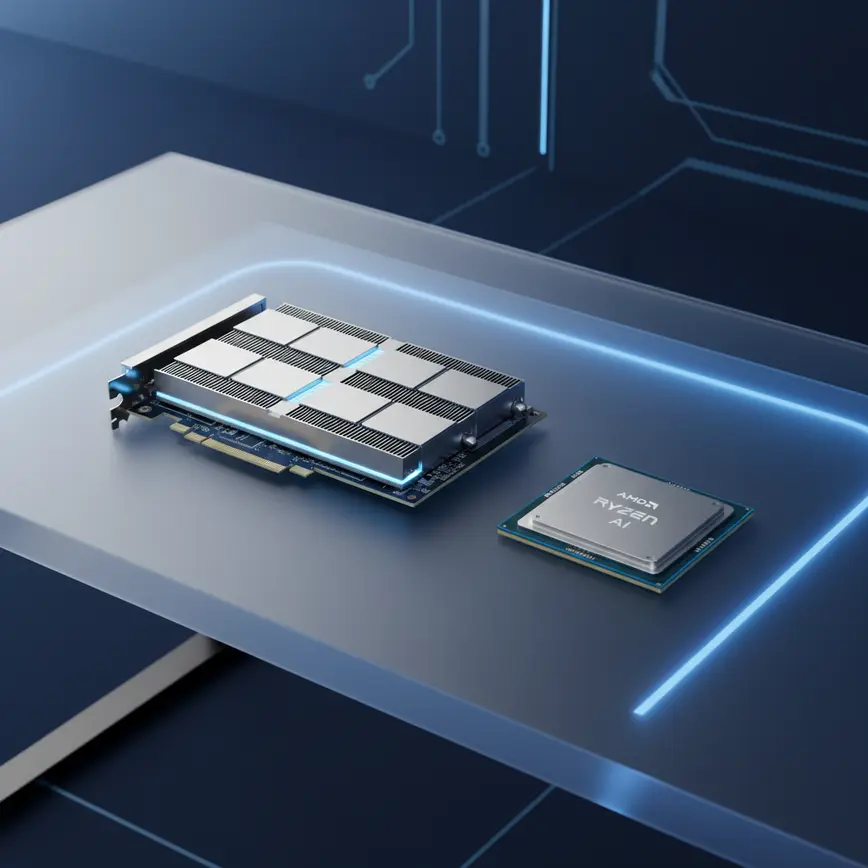
The AMD Instinct™ GPU series represents the company’s high-performance accelerators engineered for large-scale AI training and inference in data centers. These GPUs are built on the CDNA™ architecture, which is specifically designed for compute-intensive workloads. Key features often include high-bandwidth memory (HBM3e) and high-speed Infinity Fabric™ links, which allow multiple GPUs to be connected into a powerful, cohesive unit for tackling enormous models like the amd instinct mi300. An official white paper from AMD describes the Instinct MI300A as the world’s first data center APU, a design that combines CPU and GPU components to reduce data transfer overhead. This makes the amd ai gpu a strong contender for demanding cloud and enterprise AI tasks.
AI PCs: Ryzen AI and the Rise of the NPU
AMD Ryzen™ AI is a technology integrated into modern AMD CPUs that uses a dedicated Neural Processing Unit (NPU) to accelerate AI tasks directly on a laptop or PC. The primary function of the NPU is to offload sustained, low-power AI workloads—such as real-time background blurring during a video call—from the CPU and GPU. This specialization can lead to significant improvements in overall system responsiveness and battery life. A 2025 study published on arXiv investigating the amd ryzen ai NPU, which is featured in processors like the amd ryzen ai 9 hx 370, found that it achieved a greater than 2.8x speedup for certain matrix multiplications and a 1.4x improvement in floating-point operations per watt while on battery power.
Edge Computing: Versal and Alveo Accelerators
For AI applications at the edge, where processing must happen locally and instantly, AMD offers its Versal™ adaptive SoCs and Alveo™ accelerators. This edge ai hardware is designed for scenarios where sending data to the cloud for analysis is not feasible due to latency, privacy, or connectivity constraints. Common use cases for this ai accelerator hardware include industrial robotics, real-time medical imaging analysis in hospitals, and smart city sensors that need to process data on-site. The amd versal adaptive socs provide a flexible platform that can be adapted for these specialized, low-latency AI inference tasks.
AMD vs. NVIDIA: A Comparison of AI Hardware Strategy
The central difference in the amd vs nvidia ai comparison lies in their core strategies. NVIDIA has built a dominant and mature ecosystem around its proprietary CUDA software, which is deeply entrenched in the AI development community. In contrast, AMD is pursuing a strategy centered on open standards with ROCm and a more diverse hardware portfolio that spans CPUs, GPUs, and adaptive SoCs. This approach aims to attract users who want to avoid vendor lock-in and require flexibility when choosing the right AI framework.
While both companies produce powerful nvidia ai hardware and AMD accelerators, architectural differences may make them better suited for different tasks. For instance, a peer-reviewed paper from the EDBT 2025 conference on graph analytics suggested that NVIDIA GPUs may perform better on more complex algorithms, while AMD-like GPUs can be more efficient for simpler ones.
Table 1: AMD vs. NVIDIA: A Strategic Comparison
| Feature | AMD | NVIDIA |
|---|---|---|
| Software Ecosystem | Open-Source (ROCm) | Proprietary (CUDA) |
| Hardware Strategy | Diverse Portfolio (CPU, GPU, FPGA) | GPU-Centric Dominance |
| Market Position | Challenger, Gaining Traction | Established Market Leader |
| Key Differentiator | Open Standards & Flexibility | Mature, Extensive Ecosystem |
The ZAYA1 AI Model: A Case Study in Hardware Diversity
The emergence of novel AI models trained on non-traditional hardware stacks is a significant development for the entire industry. The ZAYA1 model serves as a compelling case study, illustrating the practical importance of a competitive and diverse hardware landscape. Its development on AMD’s platform highlights a shift away from a single-provider ecosystem.
What We Know About the ZAYA1 Architecture
ZAYA1 is a specialized generative ai model reportedly designed for complex hardware design simulations. While specific details remain limited, its architecture is understood to be uniquely optimized to leverage the parallel processing capabilities and high memory bandwidth of AMD’s CDNA architecture, which is found in the Instinct GPU series. Unlike more general-purpose language models, ZAYA1 is described as a multimodal model that can interpret and generate outputs based on both text-based design specifications and visual schematic diagrams, making it a powerful tool for engineers.
Why Training on AMD Hardware is a Game-Changer
For years, the AI industry has shown a heavy reliance on a single hardware provider, creating what some experts call a “foundation model monoculture.” Research from the Stanford Center for Research on Foundation Models (CRFM) warns that such monocultures “have been conjectured to lead to correlated failures and cultural homogenization,” stifling innovation and introducing systemic risks. The successful training of a cutting-edge model like ZAYA1 on AMD hardware is a significant step toward mitigating these risks.
It validates AMD’s platform as a viable and powerful alternative for high-stakes AI research and development. This increase in hardware diversity can foster a more resilient and competitive ecosystem, potentially leading to lower costs, greater innovation, and the creation of specialized hardware-software solutions tailored to specific types of AI problems.
FAQ Section – Answering Your Key Questions
Is AMD working on AI?
Yes, AMD is heavily involved in AI. The company develops a full ecosystem for artificial intelligence, including high-performance Instinct™ GPUs for data centers, Ryzen™ AI processors with dedicated NPUs for PCs, and the open-source ROCm™ software stack for AI developers. This comprehensive approach positions them as a key player in the AI hardware and software market.
Is AMD competing with Nvidia in AI?
Yes, AMD is a primary competitor to NVIDIA in the AI market. While NVIDIA currently holds a dominant market share with its CUDA platform, AMD competes directly with its Instinct™ series of GPUs and its open-source ROCm™ software platform. AMD’s strategy focuses on providing a powerful, open alternative to attract developers and enterprises seeking to avoid vendor lock-in.
What is the AMD deal with OpenAI?
There is no formal, exclusive “deal” between AMD and OpenAI. However, the two companies collaborate within the broader tech ecosystem. For instance, Microsoft, a major partner of both OpenAI and AMD, has announced it will offer AMD’s flagship MI300X AI chips to its Azure cloud customers, which can be used to run large language models and other AI workloads.
What is AI hardware?
AI hardware refers to specialized processors designed to accelerate artificial intelligence and machine learning tasks. This includes Graphics Processing Units (GPUs), Neural Processing Units (NPUs), and other accelerators like FPGAs and ASICs. These components are optimized for the parallel mathematical computations, like matrix multiplication, that are fundamental to training and running AI models efficiently.
Is AI software or hardware?
AI is both software and hardware working together. The AI models and algorithms are software, but they require powerful, specialized hardware (like GPUs or NPUs) to run efficiently. The software defines the task and the logic, while the hardware provides the computational power necessary to perform the billions of calculations required for AI applications at a practical speed.
Limitations, Alternatives, and Professional Guidance
Research Limitations
It is important to acknowledge that the AI hardware landscape is evolving at a rapid pace, and performance benchmarks can become outdated quickly. Direct, apples-to-apples comparisons between different architectures are notoriously complex, as performance often depends on the specific AI model, software optimization level, and workload. For example, a 2024 paper on arXiv highlighted that “numerical discrepancies were observed in… 9.00% of FP32 runs when comparing NVIDIA vs AMD results,” underscoring the challenges of achieving perfect cross-platform reproducibility.
Alternative Approaches
While AMD and NVIDIA are major players, they are not the only ones in the AI hardware space. Other significant contributors include Google with its Tensor Processing Units (TPUs), Amazon with its Trainium and Inferentia chips, and Intel with its Gaudi accelerators. These alternatives are often highly specialized for their own hyperscale cloud environments or specific types of AI workloads. For certain tasks, particularly at a smaller scale or for applications requiring unique flexibility, high-end CPUs or Field-Programmable Gate Arrays (FPGAs) can also be viable alternatives to GPUs.
Professional Consultation
Selecting the right AI hardware for an enterprise or major research project is a significant decision with long-term consequences. It is advisable to consult with solutions architects or MLOps professionals to conduct a thorough assessment of your specific needs. This evaluation should consider factors such as budget, required scale, the existing software stack, power consumption, and long-term strategic goals. Whenever possible, teams should consider performance testing on different platforms with their actual workloads before committing to a large-scale deployment.
Conclusion
In summary, the amd ai ecosystem appears to be a formidable and expanding force within the technology industry, offering a diverse and open alternative for developers, researchers, and enterprises. The strategy is built upon two core pillars: a versatile hardware portfolio that addresses needs from the data center to the edge, and the open-source ROCm software stack designed to foster a more accessible development environment. The success of specialized projects like ZAYA1 reinforces the critical importance of hardware diversity for maintaining a healthy, innovative, and resilient global AI industry.
Hussam’s AI Blog is a dedicated resource for professionals seeking deeper, practical insights into complex AI technologies and their applications. Our mission is to provide expert, data-scientist-led guides that cut through the noise and deliver actionable knowledge. To continue exploring the practical application of AI tools and frameworks, Read more of our in-depth guides.
References
- Dell Technologies. (n.d.). AMD AI Solutions on Dell AI Factory. Retrieved from https://www.delltechnologies.com/asset/en-us/solutions/business-solutions/briefs-summaries/amd-ai-solutions-on-dell-ai-factory-ebook.pdf
- Stanford University Medical Center. (n.d.). What is Artificial Intelligence? Lane Medical Library. Retrieved from https://laneguides.stanford.edu/AI/what-is-ai
- Kleftakis, Y., Gounaris, A., & Tsoumakas, D. (2025). An Experimental Study of Graph Analytics on Different GPU Architectures. EDBT 2025 Conference. Retrieved from https://openproceedings.org/2025/conf/edbt/paper-175.pdf
- State of AI Report. (2025). The State of AI Report 2025. Retrieved from https://www.stateof.ai
- AMD. (n.d.). AMD CDNA 3 Architecture. Retrieved from https://www.amd.com/content/dam/amd/en/documents/instinct-tech-docs/white-papers/amd-cdna-3-white-paper.pdf
- Chen, Z., et al. (2025). Unlocking the AMD Neural Processing Unit for Practical and Efficient ML Training on AI PCs. arXiv. Retrieved from https://arxiv.org/html/2504.03083v1
- Stanford Center for Research on Foundation Models. (n.d.). Open Foundation Models. Retrieved from https://crfm.stanford.edu/open-fms/
- Garg, A., et al. (2024). Finding Numerical Differences between NVIDIA and AMD GPUs for Scientific Applications. arXiv. Retrieved from https://arxiv.org/html/2410.09172v1