🔑 Key Takeaway
AI infrastructure is the complete stack of hardware, software, networking, and data center facilities required to develop, train, and deploy artificial intelligence models. It consists of core components like GPUs, high-speed networking, and specialized storage. Global investment is surging, exemplified by a recent $20B joint venture involving Qatar. This boom is driven by a geopolitical race for technological dominance and commercial advantage. Understanding this foundation is critical for anyone in the technology and business sectors. Read on for a complete guide to the components, investments, and strategic implications of this technological gold rush.
The foundational hardware and software stack essential for machine learning is known as ai infrastructure. The massive scale of investment in this area is highlighted by a groundbreaking $20B joint venture involving Qatar, serving as a prime example of its escalating global importance. From a data scientist’s perspective, this article examines the real-world implications of this trend, moving beyond the headlines to analyze what this technological arms race means for the future of computing, business, and global power dynamics.
This trend is not just about building more data centers; it represents a strategic race for future economic and technological dominance. This article deconstructs the core components of this digital foundation, analyzes the global investment landscape, and provides a deep dive into the Qatar case study. Furthermore, it answers key questions about the cost, challenges, and impact of this technological shift. Let’s begin by deconstructing what makes this digital foundation so powerful.
ℹ️ Transparency
This article explores AI infrastructure based on publicly available data and scientific research. All information is based on verified studies and reviewed by Hussam Kazim. Our goal is to inform you accurately.
What is AI Infrastructure? Deconstructing the Digital Foundation
Unlike traditional IT, ai infrastructure is purpose-built for the parallel processing and massive datasets that are essential for machine learning algorithms. It is an ecosystem designed for performance, scale, and the unique computational demands of training and deploying AI models. This specialized foundation is built on three core pillars:
Core Hardware: GPUs, TPUs, and AI Data Centers
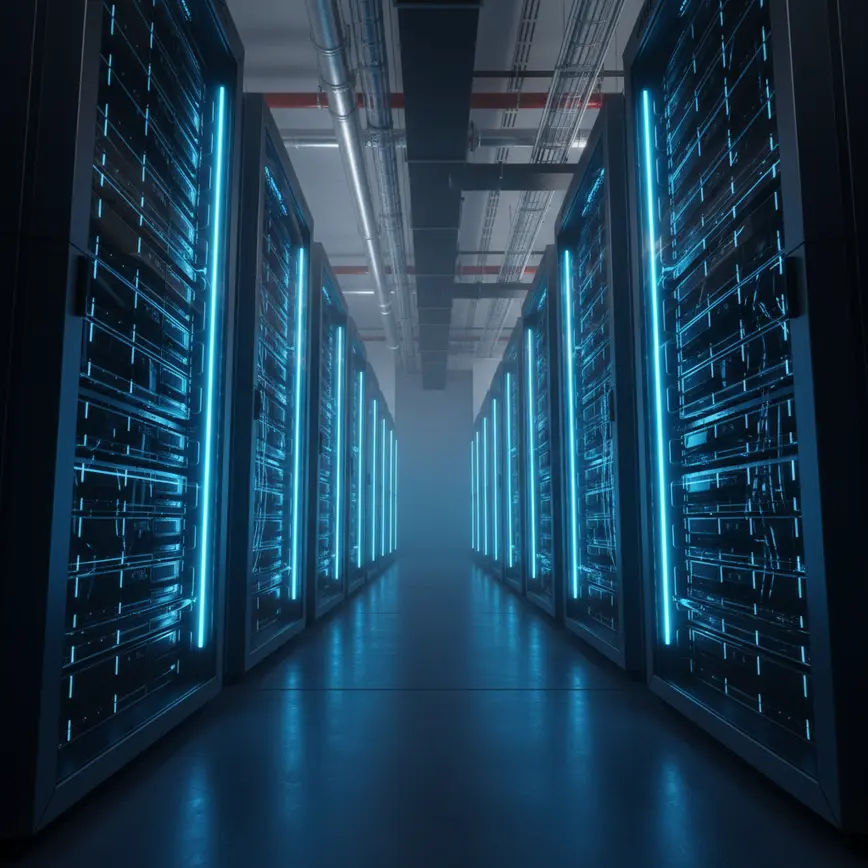
The workhorses for the parallel computation required in AI training are specialized processors like GPUs (Graphics Processing Units) and TPUs (Tensor Processing Units). An ai data center is a facility specifically optimized to handle the immense power and cooling demands these processors generate. According to a technical design guide from Juniper Networks, modern ai data center infrastructure often separates clusters into training, inference, and storage segments, each with dedicated, high-speed network fabrics to handle the intense data flow. This design, often featuring technology from providers like nvidia ai infrastructure, is crucial for efficient model development.
Software & Frameworks: The Brains of the Operation
Powerful hardware is less effective without the software to direct it. The ai infrastructure stack relies on popular AI frameworks like TensorFlow and PyTorch, which provide the libraries and tools for building models. To manage and scale these complex AI workloads, containerization technologies such as Docker and orchestration platforms like Kubernetes are frequently used. This software layer enables data scientists to deploy and manage generative ai infrastructure efficiently across vast clusters of machines.
Networking and Data: The Connective Tissue
To function as a cohesive unit, thousands of GPUs must communicate with minimal delay. This requires high-bandwidth, low-latency networking. An analysis by RCR Wireless points to technologies like InfiniBand and 400Gbps Ethernet as critical for this purpose. Alongside networking, fast and scalable storage solutions are essential for data infrastructure for ai. These systems must be capable of feeding massive datasets to the models during training, a process that involves intensive ai data analytics and transfer operations. With this understanding of the components, let’s examine the global race to build them.
The Global AI Investment Landscape: A Multi-Trillion Dollar Race
National Strategies: The Geopolitics of AI Dominance
Nations increasingly view AI leadership as critical for maintaining economic competitiveness and military strength. In a 2024 analysis, the Council on Foreign Relations described AI as a “pivotal arena of strategic competition,” particularly between the U.S. and China, framing it as a key determinant of national power in the twenty-first century. This has ignited a global race, with governments pouring billions into research, talent development, and infrastructure projects. While the US and China are the primary contenders, this surge in ai investment is drawing in other nations, creating a complex global ai ecosystem of competition and collaboration.
Corporate Giants: The Tech Titans Fueling the Boom
This national competition is often fueled by the world’s largest technology companies. Corporations like NVIDIA, Microsoft, Google, and Amazon Web Services (AWS) are at the forefront, building the hardware and cloud platforms that power the AI revolution. In its 2025 Magic Quadrant reports, market analysis firm Gartner recognized Microsoft and Google as “Leaders” for their ability to provide the foundational infrastructure for enterprise AI. These top ai infrastructure companies are making colossal investments to expand their capabilities, as seen in the table below. A prime example of this blend of national ambition and corporate execution is Qatar’s recent, massive investment.
| Corporation | Announced Investment ($USD) | Key Focus Area | Geographic Region |
|---|---|---|---|
| Microsoft | $10 Billion+ | Cloud Platform, Data Centers, Chip Design | Global |
| $12 Billion+ | AI Research, Cloud Platform, Chip Design | Global | |
| Amazon (AWS) | $15 Billion+ | Data Centers, Cloud Platform | Global |
| NVIDIA | $8 Billion+ | Chip Design, Software Ecosystem | Global |
Note: Investment figures are based on publicly announced plans and may vary. This table illustrates the scale of ai infrastructure investment.
Case Study: Qatar’s $20B AI Gambit with Brookfield
Breaking Down the $20 Billion Deal
In a landmark move, Brookfield Asset Management and Qatar’s sovereign wealth fund have reportedly entered into a joint venture valued at over $20 billion. According to a report from Bloomberg, the primary goal of this ai partnership is to build a global network of advanced AI data centers. This represents one of the largest single investments ever made in the sector, signaling a major push by new global players to secure a foothold in the foundational layer of the AI economy. The scale of the qatar ai investment underscores the immense capital required to compete at the highest level.
Beyond the Investment: Qatar’s National AI Strategy
This massive investment is not a standalone event but a cornerstone of a much broader national vision. It directly aligns with the official “National Artificial Intelligence Strategy for Qatar,” which the
qatar ai strategy positions the Brookfield JV as a critical enabler for achieving the country’s long-term economic goals as outlined in the Qatar National Vision 2030.
Implications for Global AI Partnerships
This partnership signifies a major shift in the global technology landscape. It highlights the growing influence of sovereign wealth funds in funding critical tech infrastructure and demonstrates the globalization of the AI race beyond the traditional hubs in the US and China. Research from the Brookings Institution suggests that AI may reinforce a “fragmented, multipolar order” where new players and alliances emerge to control essential infrastructure. Such collaborations, like the global partnership on ai, can accelerate the deployment of ai infrastructure globally, potentially democratizing access but also creating new geopolitical dependencies. These large-scale developments raise many practical questions, which we will now answer.
FAQ – Answering Key Questions on AI Infrastructure
What is AI infrastructure for beginners?
Think of it as the complete kitchen needed to cook an AI meal. You need the hardware (a powerful oven—the GPUs), the software (the recipe—AI frameworks), the network (fast assistants passing ingredients), and a specialized building with massive power and cooling (the kitchen itself—the data center). All these parts work together to create and run AI applications, from training a model to deploying it for users.
Who is the leader in AI infrastructure?
There isn’t one single leader, as it depends on the layer of infrastructure. NVIDIA is the dominant leader in AI chips (GPUs). In cloud services that provide AI infrastructure, companies like Amazon Web Services (AWS), Microsoft Azure, and Google Cloud are the primary leaders. For enterprise on-premise solutions, companies like HPE are also major players. The market is a competitive ecosystem rather than a monopoly held by one company.
What are some examples of AI infrastructure?
Examples range from physical hardware to cloud-based services. Hardware examples include NVIDIA’s DGX servers (which are packed with GPUs), Google’s Tensor Processing Units (TPUs), and specialized AI data centers with advanced cooling systems. Software and platform examples include cloud offerings like Amazon SageMaker, Microsoft Azure Machine Learning, and the open-source TensorFlow and PyTorch frameworks that run on this hardware to build and deploy models.
What are the challenges of AI infrastructure?
The primary challenges are immense cost, complexity, and resource constraints. Building and maintaining AI infrastructure requires massive capital investment in specialized hardware. Other key challenges include managing the extreme power consumption and cooling needs, ensuring high-speed data transfer without bottlenecks, and finding skilled talent to manage these complex systems. Scaling these systems efficiently without incurring prohibitive costs remains a significant technical hurdle for many organizations.
How much does AI infrastructure cost?
The cost can range from thousands to billions of dollars. A single high-end AI server equipped with multiple GPUs can cost over $300,000. Building a large-scale data center for AI can cost hundreds of millions or even billions, as seen in major corporate and national investments. The total cost includes not just hardware but also power, cooling, networking, software, and the specialized personnel required to operate the system over its lifetime.
What is the environmental impact of AI data centers?
The environmental impact is significant, primarily due to high energy and water consumption. AI data centers require vast amounts of electricity to power GPUs and advanced cooling systems to prevent overheating. A 2025 peer-reviewed study in Nature Sustainability estimated that U.S. AI servers could have an annual water footprint of over 1,000 million cubic meters for cooling and electricity generation, raising serious sustainability concerns that the industry is actively working to address.
Limitations, Alternatives, and Professional Guidance
Research Limitations
It is important to acknowledge that the field of AI is evolving at a rapid pace, and today’s leading technologies may be superseded quickly. Public data on the exact costs and power consumption of private data centers is often estimated, as companies typically treat this information as proprietary. Furthermore, a report by a strategic assessment to determine whether to build, buy, or rent compute resources based on specific workload needs, budget constraints, and long-term strategic goals. A phased approach to investment is often recommended to avoid the risks of over-provisioning and to allow for flexibility as technology and business needs evolve.
Conclusion
In summary, ai infrastructure is the critical, capital-intensive foundation of the modern AI revolution. The joint venture involving Qatar is a powerful indicator of a global trend where national ambitions and corporate interests are converging to build this essential foundation. This digital backbone, composed of specialized hardware, sophisticated software, and high-speed networking, faces significant challenges, including immense cost, high power consumption, and operational complexity. While the potential for innovation is enormous, the financial and environmental costs are substantial.
This complex and rapidly evolving field connects directly to the practical world of development and automation. Understanding the foundational layer is key to appreciating the tools and platforms that run on it. As the race to build this infrastructure continues, it will shape the technological capabilities available to businesses and developers for years to come. To dive deeper into the tools that run on this infrastructure, read more of our practical guides on Hussam’s AI Blog.
References
- Juniper Networks. (n.d.). Designing Data Centers for AI Clusters. Retrieved from https://www.juniper.net/documentation/us/en/software/nce/ai-clusters-data-center-design/ai-clusters-data-center-design.pdf
- RCR Wireless. (2025). AI-optimized data center components. Retrieved from https://www.rcrwireless.com/20250407/fundamentals/ai-optimized-data-center
- Council on Foreign Relations. (2024). The Contest for AI Dominance. Retrieved from https://www.cfr.org/article/contest-ai-dominance
- Gartner. (2025). Magic Quadrant for Distributed Hybrid Infrastructure. As cited by Microsoft. Retrieved from https://azure.microsoft.com/en-us/blog/microsoft-named-a-leader-in-the-2025-gartner-magic-quadrant-for-distributed-hybrid-infrastructure/
- Qatar Ministry of Communications and IT. (2019). National Artificial Intelligence Strategy for Qatar. Retrieved from https://www.mcit.gov.qa/wp-content/uploads/sites/4/2025/02/nationalartificialintelligencestrategyforqatar2019_en.pdf
- The Brookings Institution. (n.d.). AI, power, and the future of global order. Retrieved from https://www.brookings.edu/research/ai-power-and-the-future-of-global-order/
- Nature Sustainability. (2025). The growing water footprint of AI. Retrieved from https://www.nature.com/articles/s41893-025-01681-y
- The Alan Turing Institute. (2022). AI Infrastructure and Skills Report. Retrieved from https://www.turing.ac.uk/sites/default/files/2022-09/aiinfrastructureandskillsreport.pdf